
Chest
Drives horizontal pressing and arm-adduction strength for major push patterns.
Horizontal press
Fly patterns
Dips
Open region index
Upper Body Exercise Atlas
Compare key movement patterns, understand muscle emphasis, and browse evidence-aware guidance in a clean visual reference you can use immediately.
No account. No personal fitness data. Just clear exercise reference.
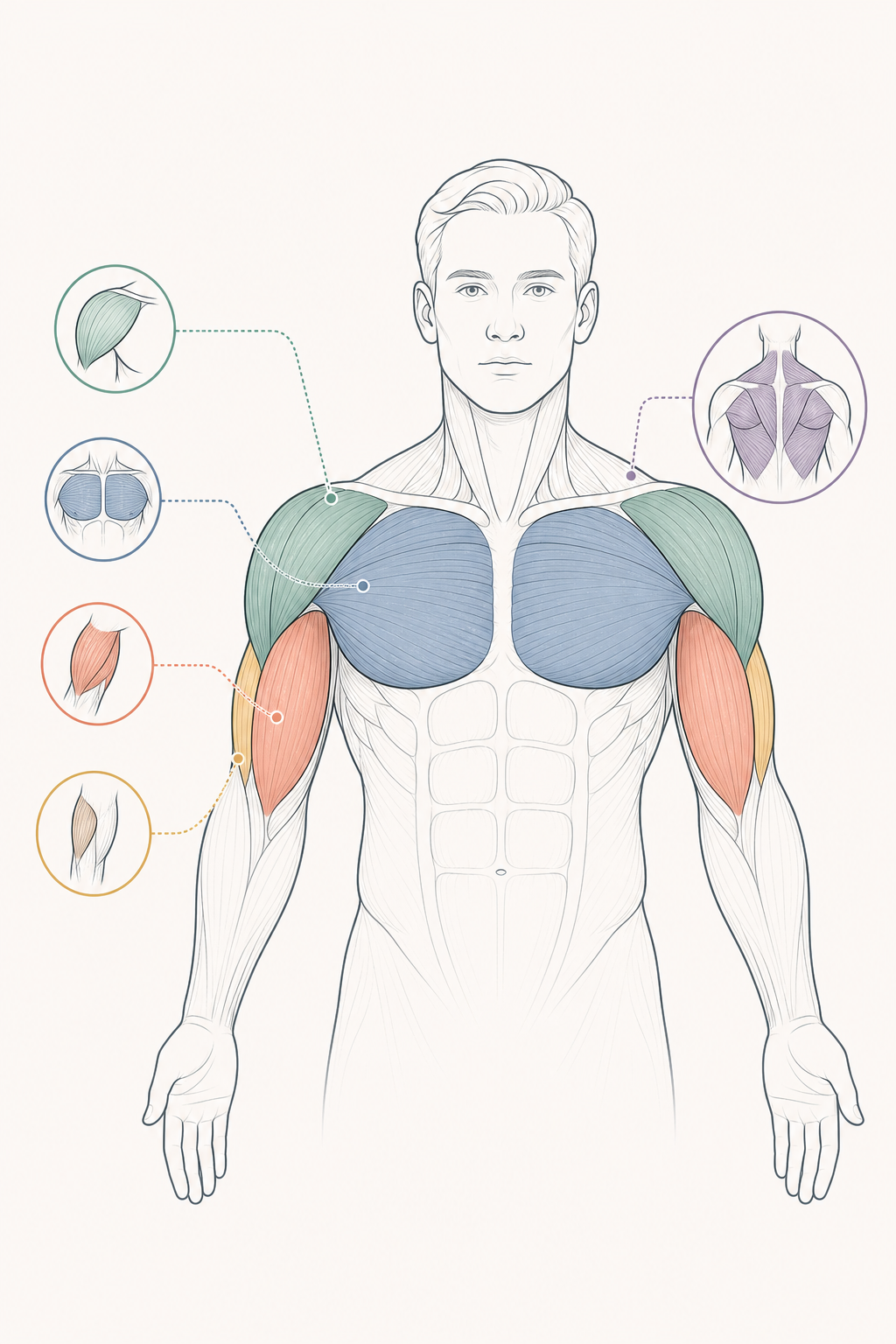
Upper-body map
Start with region first, then choose movement patterns. Use this index to move quickly from broad anatomy to specific exercise families.
Drives horizontal pressing and arm-adduction strength for major push patterns.
Supports pulling power, posture control, and efficient scapular movement.
Produces overhead force and guides arm positioning through range.
Assists elbow flexion and forearm supination in pulling tasks.
Extends the elbow for pressing lockout and overhead stability.
Builds grip endurance and wrist control for stable load handling.
Exercise taxonomy
Anatomy tells you what is involved; movement patterns clarify how exercises relate. Use this map before you compare specific lifts.
Press load away from the torso in a front-to-back plane; chest, anterior deltoid, and triceps drive the action.
Drive load overhead with shoulder flexion/abduction while triceps finish elbow extension.
Pull resistance toward the torso in a horizontal plane; upper back and rear deltoid coordinate scapular retraction.
Draw load from overhead toward the ribcage through shoulder adduction and elbow flexion.
Bend the elbow under load to train biceps and brachialis, often with supinated or neutral grips.
Straighten the elbow against resistance to emphasize triceps through long and lateral head loading.
Comparison method
No upper-body exercise is universally “best” — useful comparisons depend on your goal, available equipment, joint comfort, and current skill level.
Movement comparisons
Each tile contrasts two common options, then gives the practical difference, when each tends to fit, and a quick tradeoff cue.
Option A
Bench press
Option B
Push-up
Practical difference
Bench press allows heavier load progression; push-ups demand full-body control with fixed bodyweight.
Bench: better for maximal chest pressing strength.
Push-up: better for no-equipment sessions and shoulder-friendly volume.
Cue: load precision vs portability.
Option A
Pull-up
Option B
Lat pulldown
Practical difference
Pull-ups are bodyweight-limited; pulldowns let you adjust resistance and reps more precisely.
Pull-up: stronger carryover to climbing and relative strength.
Pulldown: easier entry point for beginners and higher-volume back work.
Cue: specificity vs scalability.
Option A
Barbell row
Option B
Seated row
Practical difference
Barbell rows load posterior chain isometrically; seated rows reduce low-back demand and isolate upper back more.
Barbell: useful when you also want hip-hinge endurance.
Seated: useful when fatigue management or form consistency matters.
Cue: whole-chain demand vs targeted back volume.
Option A
Overhead press
Option B
Lateral raise
Practical difference
Pressing trains multi-joint strength overhead; lateral raises bias side delts with lower systemic load.
Press: strong choice for global shoulder and triceps strength.
Raise: strong choice for hypertrophy-focused delt volume.
Cue: performance output vs local muscle emphasis.
Option A
Barbell curl
Option B
Incline DB curl
Practical difference
Barbell curls favor heavier bilateral loading; incline dumbbells increase long-head stretch and range.
Barbell: simple progression and time-efficient sets.
Incline DB: useful when chasing fuller biceps tension.
Cue: max load convenience vs stretch stimulus.
Option A
Overhead extension
Option B
Cable pressdown
Practical difference
Overhead extensions bias long-head stretch; pressdowns are easier to stabilize for strict lockout volume.
Overhead: strong fit when arm-behind-head range is pain-free.
Pressdown: strong fit for high-rep finishers and elbow comfort.
Cue: stretch bias vs stable repetition quality.
Evidence principles
Use these as a quick filter when comparing movements and planning sessions.
Increase load, reps, or control gradually so adaptation continues without unnecessary jumps.
Choose patterns that match your goal: strength, hypertrophy, skill, or movement confidence.
Select exercises that respect equipment access, comfort, time, and any current limitations.
Repeat stable setup and tempo so week-to-week comparisons are meaningful and safer.
FAQ
Short, practical answers to help you choose movements with confidence and keep your training decisions clear.
Start with your goal and comfort: flat pressing usually favors overall chest strength, while incline pressing shifts emphasis toward upper chest and front delts. Keep the variation that feels stable in your joints, then progress load or reps consistently.
Yes. Machines can provide predictable resistance and easier setup, which is useful for learning effort levels or training around fatigue. Free weights add more coordination demands, so many effective programs use both rather than treating one as inferior.
Think in primary movers plus assistants. A row is mostly back work but still trains biceps and rear delts; a press is mostly chest/shoulder/triceps together. Use targeting as a direction, not a promise of isolation.
Usually no. Most beginners do best with a small set of repeatable patterns (press, row, vertical push/pull) and clear progression. Add variation gradually when technique is stable or when a movement no longer fits your needs.
Use research to guide priorities, then keep decisions practical. Strong basics—adequate effort, consistent volume, and repeatable technique—matter more than chasing tiny study-level differences between similar movements.
Keep exploring the atlas to compare movement patterns side by side and refine your exercise choices over time.